




Description
Who this Medline monitor is for, and a naming point
This is an upper arm automatic blood pressure monitor with a universal cuff, a carrying case, memory for three users and an averaging function. It records numbers for a clinician to review. It is not a diagnostic device and it does not replace professional medical care.
The naming needs sorting out first, because three different names attach to the same product. Our page has carried the name Elite. The retail listing title calls it the Medline Advanced Automatic Blood Pressure Monitor. The product description then refers to it as the Medline Elite Automatic Blood Pressure Monitor. The model number, MDS3001U, is the only stable identifier. Order by the model number.
The buyer it suits is a household of up to three people who want separate records without an app, and who value a case for taking the device to appointments.
Cuff range and the specifications that matter
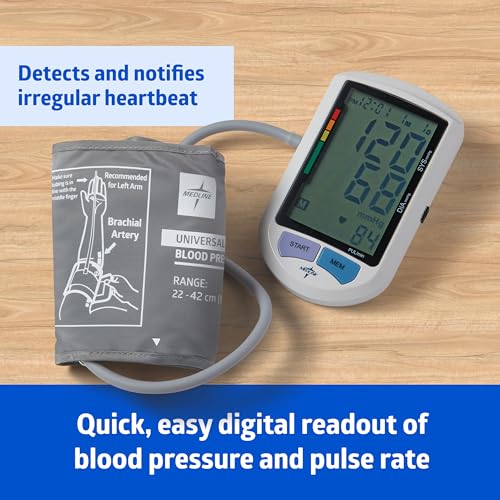
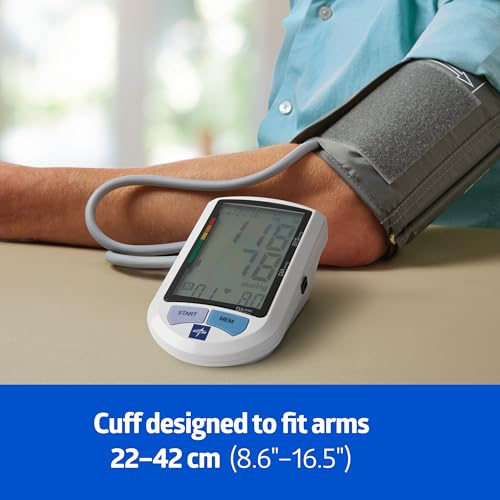
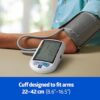
The supplied cuff is described as a universal upper arm cuff covering 22 to 42 cm, which is 8.6 to 16.5 inches. That is a wide range cuff and it covers most adults. Note that our stored band size attribute records only 16.5 inches, dropping the lower bound, so use the full range as given here. Measure your bare upper arm at the midpoint between shoulder and elbow with a tape measure before ordering.
Cuff fit is the specification that governs whether a reading means anything. A cuff too small or too large for the arm gives a number that does not match what the same device records on a properly fitted arm, and the display will not tell you.
Memory, averaging and the inflation method
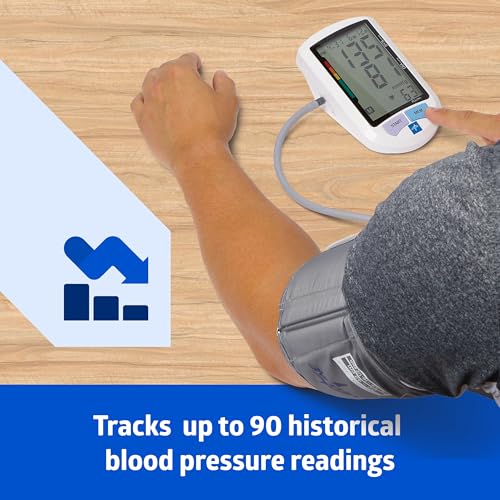
The monitor stores up to 90 measurements, holds separate memory for up to three users and displays the average of the last three readings. Three user memory is unusual at this level, where two is the norm, and the three reading average is worth using because single readings vary for ordinary reasons.
Medline describes two design choices worth noting. The first is customized inflation, where the cuff inflates to a level judged for the individual rather than to a fixed pressure every time, with error detection. The second is what the description calls measure during deflating technology, meaning the reading is taken as the cuff releases rather than as it fills. Both are comfort and reliability features rather than measurement claims. The box contains the monitor, the universal cuff, a carrying case and four AA batteries, and Medline states a two year warranty. The unit measures about 7.25 by 4.75 by 4 inches.
The claims in this listing, and how to read them
This listing uses stronger language than most, and it needs attributing rather than repeating. Medline heads one feature with the phrase clinical accuracy, describes the device as designed for professional results without an office visit, and refers to a comparative scale for comparing your results against optimal readings.
We do not test products and we will not describe any monitor as clinically accurate, medical grade or a substitute for a measurement taken in a clinic. Those are the manufacturer’s words. No independent validation protocol and no assessing body is named anywhere in this listing, and where a home monitor has been assessed against a published protocol, the protocol is normally identified by name. If that assurance matters to your decision, look this model number up on an independent validation listing.
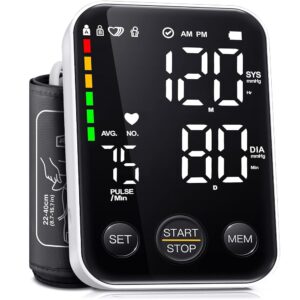
The colored scale beside the display is a category indicator driven by thresholds the manufacturer has programmed. We are not reproducing those thresholds here as targets. A colored band is a prompt to raise a reading with a clinician, not an interpretation of it, and the phrase optimal readings in a retail description is marketing rather than a clinical target set for you personally.
Using it correctly, and what the readings are for
Sit with your back supported and your feet flat on the floor rather than crossed, and rest quietly for several minutes before you measure. Fit the cuff on a bare upper arm rather than over a sleeve, and support the arm so the cuff sits at about the height of your heart. Do not talk during the measurement. If you are using the three reading average, stay seated through the sequence. Use the same arm at about the same time each day.
What you collect is a record to hand over. What a reading means, whether a pattern in your readings is significant, and whether anything about your care should change are questions for a healthcare professional who knows your history and your treatment. This monitor does not replace professional medical care, and no reading from it should be used to adjust medication.
Limits and gaps
No irregular heartbeat detection is described anywhere in this listing, so if you want a device that flags an irregular rhythm for a clinician, this listing does not claim to do it. There is no app and no wireless connection, so 90 measurements shared across three users is the full history unless you write readings down, and 90 across three people is closer to 30 each. Battery life is not published, no AC adapter is listed, and no display dimension is given beyond the word large.
A note on our own earlier summary of this product, which stated that its readings match professional medical devices. Nothing in the listing supports that comparison, we did not measure anything, and we have removed it.
A note on sharing a monitor between three people, since that is this model’s distinguishing feature. Three user memory only helps if everyone selects their own user slot before measuring, and the most common way these records get spoiled is a guest or a family member taking a reading under whoever was last selected. Get into the habit of checking the user indicator before the cuff goes on. It is also worth agreeing who uses which slot and writing it inside the case lid, because the display shows a number rather than a name.
Alternatives worth comparing
Within the same brand, the Medline MDS4001, which is supplied with a narrower standard cuff is worth checking against this one specifically on cuff range, and the Medline MDS4003 and Medline MDS7001B are the other family members. Outside Medline, the A and D UA-767FAC with four user memory goes further on multi user support, and the Microlife BPM2, which names an independent validation rating is the comparison if the validation question is what is bothering you. Our index of home monitors and cuffs lists the cuff range each publishes.
Who should buy it and who should not
Buy it if three people need separate records, arms measure between 8.6 and 16.5 inches, and a case and an averaging function matter more than connectivity. Do not read the clinical language in the listing as independent validation, do not buy it if you want irregular heartbeat flagging, and do not rely on 90 shared readings as a long history. Take what you record to a clinician.