




Description
Who the Microlife BP3GY1-2N is for
This is an upper arm automatic blood pressure monitor, sold as the Microlife Series 800, with Bluetooth, a wide range cuff, two user memories of 120 readings each and a guest mode. It records numbers for a clinician to review. It is not a diagnostic device and it does not replace professional medical care.
The decision it settles is about household use. Two named users with 120 readings each, plus a guest mode that takes a measurement without storing it, is a better structure than most competing devices offer. The guest mode in particular solves a common annoyance: a visitor or a second family member taking one reading and contaminating somebody’s record.
Cuff range and the specifications that matter
The supplied cuff covers upper arm circumferences of 8.7 to 16.5 inches, given as 22 to 42 cm, and an XL cuff fitting up to 20.5 inches is sold separately. The stored attribute agrees with the standard range. Measure the circumference of your bare upper arm with a cloth tape, midway between elbow and shoulder, before ordering.
The listing states the point directly, and it is the correct emphasis: proper fit is necessary for an accurate reading. A cuff that is too small or too large produces a number that does not match what the same device would record with a correctly sized cuff, and nothing on the display warns you that it has happened. If you are near 16.5 inches, price the XL cuff at the same time rather than discovering the problem after delivery.
MAM averaging, which is the function worth having
Microlife’s averaging mode takes three readings in succession, analyzes them automatically and displays a result, and the listing explains the reasoning plainly: a single measurement is less reliable than a short series because blood pressure fluctuates. That is the most useful feature on this device. Doing it automatically means it happens every time rather than when you remember.
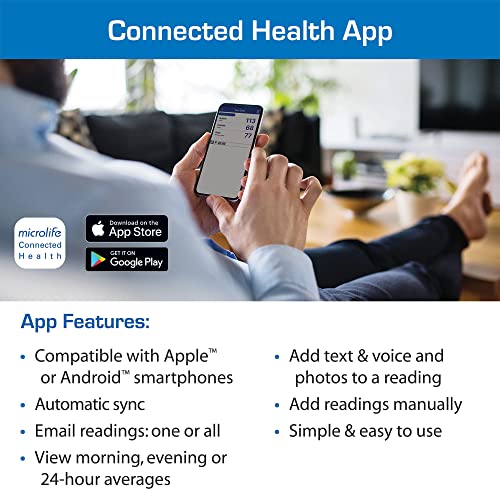
The app side adds tracking of pressure and pulse, reminders to measure and to take medication, the ability to send results to a healthcare provider, and a choice between cloud storage and a privacy mode that keeps readings local. The privacy option is worth noting, because it is not something most competing apps offer. The unit measures about 5.8 by 3.4 by 1.7 inches.
Using it correctly, and what the readings are for
Sit with your back supported and your feet flat on the floor rather than crossed, and rest quietly for several minutes before you start. Fit the cuff on a bare upper arm rather than over a sleeve, and support the arm so the cuff sits at about the height of your heart. Do not talk during the measurement, and if you are using the three reading sequence, stay seated and still through all three rather than moving between them. Use the same arm at about the same time each day.
What you produce is a record for someone else to read. What a reading means, whether a pattern across your readings is significant, and whether anything about your treatment should change are questions for a healthcare professional who knows your history. This device does not replace professional medical care, and no reading from it should be used to start, stop or adjust medication on your own. The ability to send results to a provider from the app is genuinely useful here, because a tidy export is easier for a clinician to read than a page of handwritten numbers.
The claims, including one about a specific condition
The listing heads a feature with the phrase clinically proven accuracy. We do not test devices and we will not describe any monitor as accurate in our own voice. Note also that no independent validation protocol and no assessing body is named in this listing, which is worth remarking on because Microlife does name a specific independent rating on some of its other listings. Check an independent validation listing for this model number if that matters to you.
The second claim requires more care. The listing states that the device offers clinical validation for accurate readings in the presence of diabetes, and describes this as a breakthrough technology for diabetics. That is Microlife’s statement about its own product and we are reporting it as such rather than endorsing it. Nothing in the listing names the study, the protocol, the assessing body or the population involved, so there is nothing here a reader can inspect.
We are not going to say anything about what diabetes does or does not mean for blood pressure measurement, because that is a clinical matter and this is a retail product page. If you have diabetes and you are choosing a home monitor partly for that reason, that is exactly the sort of question to put to your own clinician or pharmacist, who can tell you whether the distinction matters for you and which devices they would suggest.
Limits and gaps
The XL cuff is a separate purchase, so the effective price for anyone above 16.5 inches is higher than the headline. No AC adapter is listed and battery life is not published. No display dimension is given. Bluetooth products carry the usual dependency: check that your phone runs a supported version of iOS or Android, and remember that the unlimited history and the reminders live on a service the manufacturer maintains.
A note on our own earlier summary of this product, which said the readings closely align with professional medical equipment. Nothing in the listing supports that comparison, we did not measure anything, and we have removed it.
Alternatives worth comparing
Within the same brand, the Microlife BPM2, which names an independent AA rating on its listing is the comparison to make if the validation question is what is bothering you, and the Microlife replacement cuff is the part to look at for fit. The Vaunn listing carrying the same underlying model number as the BPM2 is another route to the same hardware. Among competing connected monitors, the Etekcity TMB-1583-BS and the Withings BPM Connect are the obvious ones. Our index of home monitors and cuffs lists cuff ranges and memory for each.
Who should buy it and who should not
Buy it if two people need separate records with a guest mode, arms fall between 8.7 and 16.5 inches, and an automatic three reading average is a function you will use. Do not buy it if you need the XL cuff and have not budgeted for it, and do not treat the statement about diabetes as anything other than the manufacturer’s own claim. Take that question, and your readings, to a clinician.