Description
Who the Omron 5 Series BP742N is for
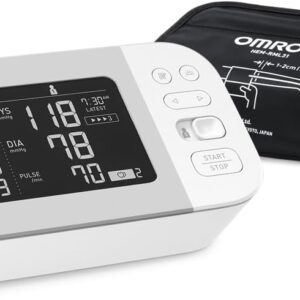
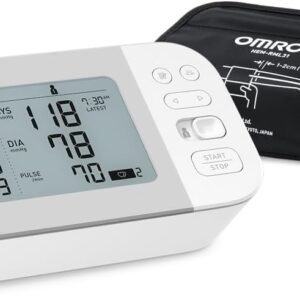
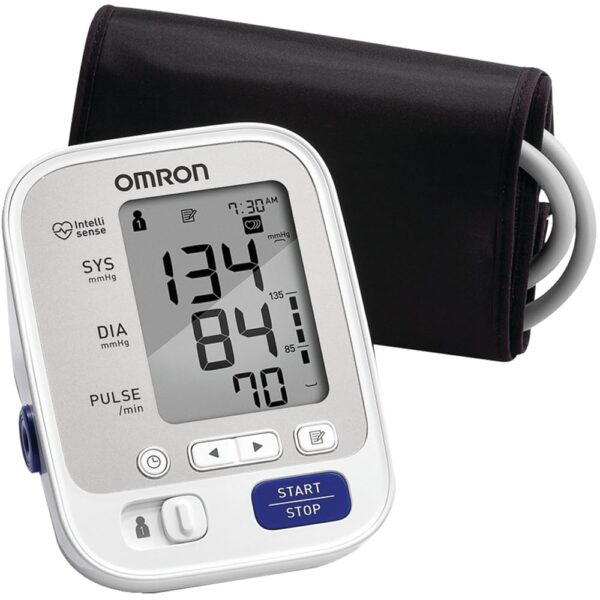
This is an upper arm automatic blood pressure monitor for home use, powered by four AA batteries, intended to be shared by up to two people in the same household. It is a device that records numbers so that you can bring them to a clinician. It is not a diagnostic instrument and it does not replace professional medical care.
The decision it settles is a practical one about household fit rather than about medical outcomes. It suits two adults in the same home who each want their own memory bank, whose upper arms fall inside the cuff range below, and who want a monitor that works without a phone, an account or an app. It does not suit anyone who wants their readings to arrive on a phone automatically, since this model has no wireless connection.
Cuff range and the specifications that matter
The cuff is the specification that decides whether anything else on this page is worth reading. The listing gives an arm circumference range of 9 to 17 inches, which the stored attribute records as 22 to 42 cm. The cuff is described as a contoured soft wide range cuff covering standard and large adult arms.
Cuff fit is not a comfort question. A cuff that is too small for the arm or too large for it produces readings that do not reflect what the same device would record on a correctly fitted arm, and the device has no way of telling you that this has happened. Measure the circumference of your bare upper arm at the midpoint between shoulder and elbow with a tape measure before ordering, and check that number against the range above. If you sit outside 9 to 17 inches, this monitor is the wrong purchase regardless of every other feature.
Memory, averaging and the irregular heartbeat symbol
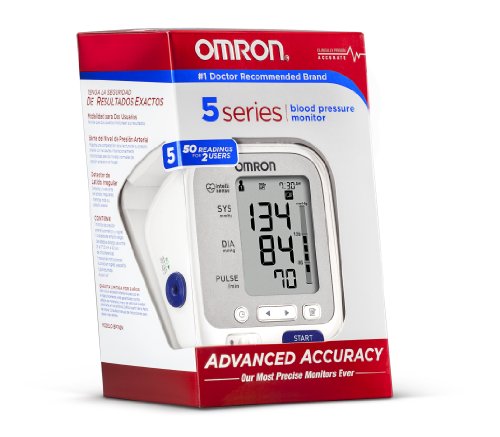
Two users can each store 50 readings, giving 100 in total, each stamped with date and time. The monitor displays the average of up to the last three readings taken within ten minutes, which is a useful function because single readings vary and a short series is a more stable record to hand over. Irregular heartbeat detection is included. That feature flags that the device noticed an irregularity during a measurement. It does not identify what the irregularity is, it does not diagnose anything, and the appropriate response to seeing it is to mention it to a clinician rather than to interpret it yourself. The package contains the monitor, the cuff, a quick start guide, an instruction manual and four AA batteries. The unit weighs 1.31 pounds.
Using it correctly, and what the readings are for
Measurement technique changes what a home monitor records more than the choice between one reasonable monitor and another. Sit with your back supported and your feet flat on the floor rather than crossed. Rest for several minutes before measuring. Put the cuff on a bare upper arm rather than over a sleeve, and support the arm so the cuff sits at roughly the height of your heart. Do not talk during the measurement. Use the same arm each time, at the same time of day, and record the readings rather than relying on memory. The listing itself carries a note that blood pressure varies constantly because of factors including stress, time of day and how the cuff is wrapped, which is an unusually candid statement for a product page and worth taking seriously.
What the numbers mean is not something this page will tell you, and it is not something the device tells you either. A home monitor produces data. Whether a pattern in that data matters, whether anything should change, and what should change are questions for a clinician who knows your history and your medication. Take the readings to that conversation. Do not start, stop or alter any treatment on the basis of a home reading, and do not use this device in place of seeking care.
Claims in the listing, and what we can and cannot confirm
This listing carries several accuracy claims and they need attributing rather than repeating. Omron describes the monitor as having what it calls Advanced Accuracy, states that it is the home blood pressure monitor brand recommended by doctors and pharmacists for clinically accurate home monitoring, and describes itself as the leading selling manufacturer in the category for over forty years. Those are the manufacturer statements. We have not measured this device, we do not test products, and we are not in a position to tell you that any monitor is accurate.
What we can tell you is what is missing. No independent validation protocol is named anywhere in the listing. Home monitors are assessed against published validation protocols run by independent bodies, and where a manufacturer has completed one it is normally named. This listing does not name one, so a reader who wants to know whether this specific model has been through independent validation should check the current status through an independent validation listing rather than taking the marketing wording as an answer.
Limits and gaps
There is no Bluetooth and no app, so readings stay on the device and go into a notebook if you want a longer history than 50 entries per person. There is no AC adapter in the listed components, so this runs on batteries unless you source an adapter separately, and battery life is not published. The stored attribute for product dimensions is recorded oddly and should not be relied on for planning shelf space.
The two user limit is a real constraint in a larger household, and there is no facility for a guest measurement that stays out of either user’s records. Finally, and this bears repeating because the whole category invites the opposite assumption, a home monitor is a record keeping tool that supports professional care rather than substituting for it.
Alternatives worth comparing
Within the same range, the Omron BP7250, a later 5 Series model and the Omron BP5100 Bronze sit either side of it, while the Omron Gold BP5350 and the Omron Platinum add connectivity and more memory. If your arm falls outside the range, a wide range replacement cuff is the thing to check compatibility on before assuming a monitor is unusable. Our index of home monitors and cuffs lists what each listing publishes for cuff range.
Who should buy it and who should not
Buy it if two people in the household need separate records, both arms measure between 9 and 17 inches, and you want a monitor that works without a phone. Do not buy it if you need readings to sync to an app, if your household has more than two regular users, or if your arm falls outside the published cuff range. Whatever you buy, the readings belong in a conversation with a clinician rather than on their own.