





Description
Read this before anything else
This is a replacement cuff sized for slim arms, and the listing describes it as pediatric. That word changes what a review of it has to say, so we are putting the important part first.
Blood pressure in children is not read the way it is in adults. There is no single set of numbers that applies, because a result is interpreted against a child’s age, sex and height, and that comparison is a clinical task. A home monitor sold to adults is generally not validated for use on children, and buying a smaller cuff does not change that. Fitting the right size band is necessary but nowhere near sufficient.
So: do not monitor a child’s blood pressure at home unless a clinician has asked you to, and if they have, ask them what equipment to use, what cuff size is appropriate for that child, and what they want you to record. Nothing on this page, and nothing on the product listing, is medical advice or a substitute for professional medical care. If you are buying this band for an adult with a slim arm, the rest of the review applies straightforwardly.
What the cuff is, and the range it publishes
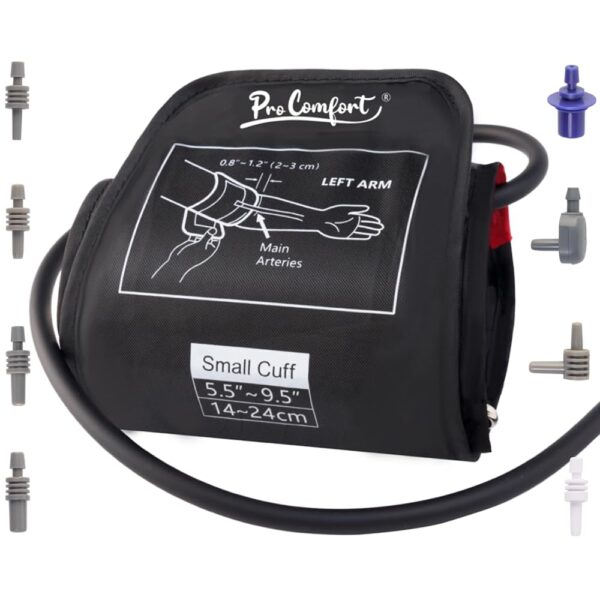
It is a fabric band with a TPU bladder and a set of connectors, with no pump, no screen and no electronics. It attaches to a monitor you already own. The intended buyer is anyone whose standard cuff is too large: a slim adult, an older person who has lost muscle, or a child under clinical instruction.
The published range disagrees with itself. The product title gives 5.9 to 9.5 inches. The first feature bullet gives 5.5 to 9.5 inches. Those are not the same band at the lower end, and the lower end is precisely where this product’s value lies. Four tenths of an inch is a real difference on a slim arm, so if your measurement is near 5.5 to 5.9 inches, get the figure confirmed by the seller before ordering rather than choosing whichever number suits.
Measure the midpoint of the upper arm, halfway between shoulder and elbow, with the arm relaxed at the side and a soft tape held snug but not tight. Buy on that measurement. A band too large for the arm cannot be seated evenly and the bladder does not sit squarely over the artery, which changes the reading on a monitor that is working correctly.
Connectors, and a count that cannot be checked
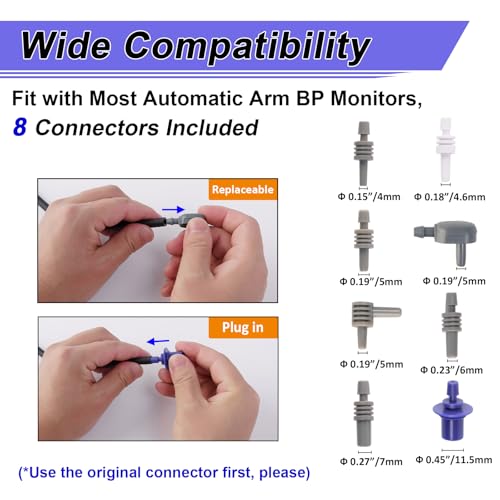
The title and the bullets both say eight connectors are supplied. The list of sizes that follows has been damaged in the import and reads as four bare numbers, 0.15, 0.19, 0.23 and 0.45, with the unit marks stripped out and the remaining four missing entirely. We are not going to guess whether those are inches or invent the four we cannot see.
Before ordering, measure the outside diameter of the plug on your existing cuff where it enters the monitor, and ask Pro Comfort to confirm that one of the supplied connectors matches. The compatibility claim in the title is with most monitors, which is broad. Some machines use proprietary fittings, some tubeless designs have no detachable cuff at all, and some are calibrated around the band they shipped with. Where a manufacturer sells its own small band for your machine, that is the lower risk purchase, as our Microlife replacement cuff review sets out.
Materials, and one field this listing gets right
Pro Comfort describes non toxic, odorless nylon fabric, a hook and loop closure and a TPU airbag, with the band described as easy to clean. Listed dimensions of 15.7 by 3.9 by 1 inches describe the band laid out flat, and listed weight is 4.16 ounces.
Worth noting in a catalog full of nonsense specification fields: this listing gives its power source as no need and its display type as no need. That is exactly right for a bare cuff, and it is the first product in this section whose data does not claim a battery or a screen on a piece of fabric. Small thing, but it suggests someone read the form.
The model name field, on the other hand, reads pediatric blood pressure cuff for small arms, which is a description rather than a model number. There is no model number anywhere in the listing, so a future reorder will have to be done from a photograph.
The inflation claim
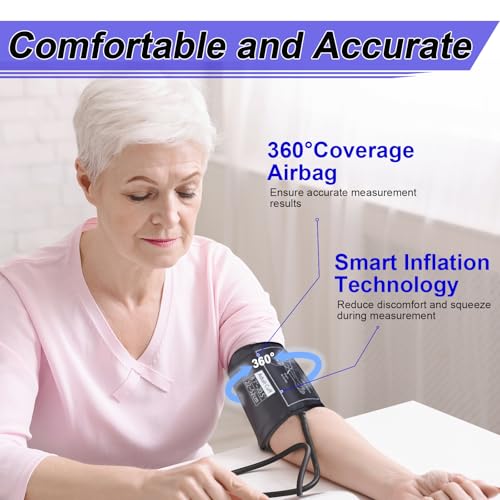
Pro Comfort states the cuff uses 360 degree smart inflation technology, that it inflates smoothly without pinching, and that this improves the precision of results and reduces the squeezing sensation during measurement. Those are the manufacturer’s claims about the band’s construction. The inflation behavior of the system is largely determined by the pump and valve inside the monitor rather than by the cuff, so treat a claim of this kind as a description of the bladder’s shape rather than as a performance figure. No protocol is named, no accuracy tolerance is published, and we make no accuracy claim about this product in our own voice.
Using it correctly
Put the cuff on a bare upper arm, not over a sleeve, with the lower edge about an inch above the elbow crease and the artery marker over the inside of the arm. Snug the band until two fingers slide under the edge with mild resistance. The person being measured should sit with their back supported and both feet flat, with the arm resting so the cuff is level with the heart, and should stay quiet and still throughout.
With a child, add one thing: a measurement taken while a child is upset, wriggling or frightened of the cuff is not a measurement worth recording. If a clinician has asked for readings, ask them how they want you to handle that, and tell them if you could not get a still, quiet measurement rather than logging one you know was compromised.
After changing a cuff, take several readings under the same conditions you used before and see whether the pattern is broadly similar. If it is not, raise it with a clinician or pharmacist rather than deciding for yourself which band to believe.
Alternatives worth comparing
The Elera pediatric cuff is the direct comparison in this catalog. For slim adult arms specifically, the CareLiving small cuff covers 14 to 24 centimeters and publishes its connector sizes in millimeters, and the Medhome small cuff covers the same span. Pro Comfort’s own extra large band sits at the other end of the ladder in our Pro Comfort XL cuff review, and the full home blood pressure equipment section lists bands next to the machines they attach to.
Who should buy it, and who should not
Buy this cuff if you are an adult with a slim arm measured inside the published range, if you have confirmed the connector fits your monitor, and if the discrepancy at the lower end does not affect you. Buy it for a child only on the instruction of a clinician who has told you what to use and what to record. Do not buy it expecting a smaller band to make an adult monitor suitable for a child, because that is not what a cuff does.