



Description
Who this GUAEVER wrist monitor is for, and what it settles
Wrist monitors usually stop somewhere around 7.7 inches of band, which quietly excludes a lot of people. GUAEVER publishes a range here of 5.3 to 9.8 inches, and that upper figure is far beyond what most wrist devices in this catalog reach. If you have tried a wrist monitor and found the band would not close, that single number is the reason to read on.
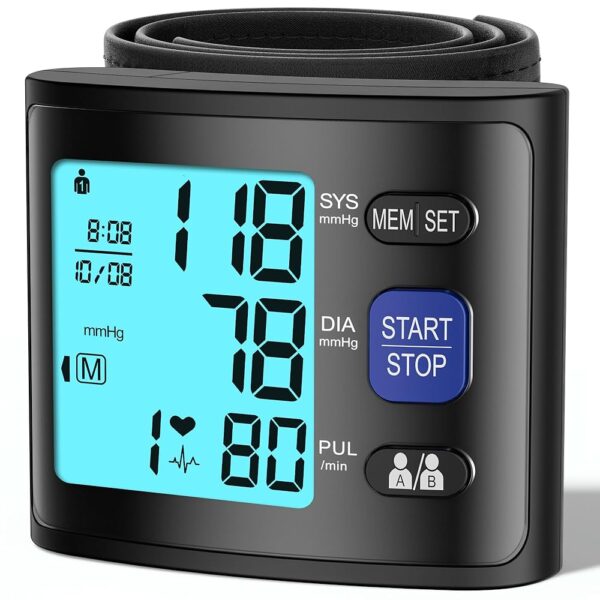
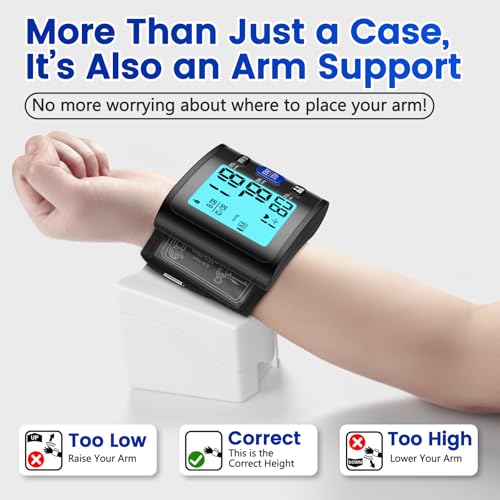
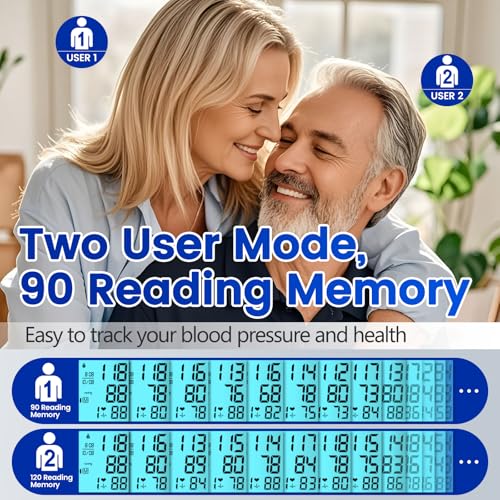
The rest is conventional: a backlit LCD, spoken guidance, one button operation, two user profiles holding 90 readings each, and a storage case that doubles as a hand rest to keep your posture consistent between measurements.
Before the specifications, the format needs stating. A wrist device is not equivalent to an upper arm device. The wrist sits further from the heart, the arteries there are smaller, and the reading moves with how the hand is held in a way arm readings do not. Upper arm monitors remain the usual recommendation for home monitoring, and a wrist unit is normally chosen when an arm cuff is impractical. If you have a free choice, read our HoMedics upper arm review first.
Nothing this device shows is a diagnosis. It does not replace professional medical care, and its readings are for the clinician who manages your health to interpret.
A claim in the listing that needs correcting
GUAEVER’s first feature bullet says the device includes a World Health Organization classification indicator for easy hypertension detection. We are flagging that rather than repeating it. No home monitor detects hypertension. What the indicator does is sort a single reading into a colored band. Hypertension is a clinical judgment made by a professional using repeated measurements over time along with everything else they know about you, and a colored bar on a wrist device is not a step in that process you can take yourself.
The same bullet describes upgraded Accurate Signal Processing technology and states the device has been through more than 100,000 reliability tests and calibrations. Those are the manufacturer’s statements. No validation protocol is named, no clearance number is quoted and no accuracy tolerance is published, so a large test count describes an internal process rather than a checkable result. We make no accuracy claim about this device in our own voice. Validation status for any home monitor is checkable independently through the lists that medical societies publish.
The specifications that matter
Band range, published once
The 5.3 to 9.8 inch figure appears in a feature bullet and nowhere else. There is no structured band size field on this listing at all, and no centimeter equivalent. That is thinner evidence than a specification, and given how much of this device’s appeal rests on the wide band, it is worth asking GUAEVER to confirm the figures in writing before ordering, particularly if your wrist is above about 8 inches.
Measure your wrist just below the bone, where a watch strap would sit. Wrist bands have very little adjustment to spare compared with arm cuffs, so a measurement close to either boundary is a genuine risk rather than a rounding question.
Memory and users
Two profiles, 90 readings each, for 180 in total, with a single MEM and SET button cycling between user A and user B. That is enough for roughly six weeks of twice daily measurements per person before anything is overwritten.
Power, size and contents
AAA batteries, supplied. The contents list names the monitor, the storage case, the batteries and a user manual. Listed dimensions are 2.9 by 2.56 by 2.56 inches and listed weight is 8.47 ounces, making this one of the smaller devices in this catalog.
What the listing does not tell you
There is no model number anywhere. Not in the title, not in a specification field, nowhere. GUAEVER sells several wrist monitors in this catalog and they are not the same hardware: our BP186W review covers a model with a narrower band, our second GUAEVER wrist listing publishes different figures again, and the BP351A is a different device entirely. Without a model number on this one, matching a replacement or a service query to the right product is going to be difficult.
The manufacturer field names Shenzhen Urion Technology, which is the same manufacturer behind the AQESO machines in this catalog, including the one covered in our AQESO U80B review. Notably, the BP186W sold under the same GUAEVER brand names a completely different manufacturer. One brand, two factories, is ordinary in this category and it means the name on the box carries less information than buyers assume.
This product also carries the lowest customer rating of any monitor in this part of our catalog, at 3.8. We do not treat ratings as evidence about accuracy, and we are not drawing a conclusion from it, but it is worth knowing before you order.
Using it correctly
The listing carries a placement instruction that is specific and correct, and worth following: put the sensor, which sits under the display, against the inside of your left wrist with the palm facing up, and make sure the device is level with your heart during the measurement.
Build the rest of the routine around it. Rest for five minutes first, sitting with your back supported and both feet flat. Bare wrist, band snug enough that it will not slide. Rest your elbow on a table and raise the wrist to roughly the middle of your chest. Support the arm rather than holding it under tension, because effort changes the result.
Use the case as the hand rest it is designed to be, but set your chair and table up once so that with your hand on the case, the wrist genuinely sits at heart height. The case fixes the angle, not the height, and the height depends on your furniture. Keep the wrist flat, stay quiet and still, and confirm the right user profile before you press start.
Who should buy it, and who should not
Buy this monitor if your wrist measures above the 7.7 inch ceiling that most wrist devices stop at, if an arm cuff is impractical for you, and if you are willing to get the band range confirmed by the seller since the listing publishes it only once. Skip it if a standard wrist band already fits you, in which case one of the better documented devices in our home blood pressure monitor section is the safer purchase, and skip it if you need a model number for future support. And whatever the colored indicator shows, treat it as a color rather than a conclusion, and take the numbers to your clinician.