


Description
Who the Konquest KBP-2910W is for, and the wrist question first
This is a wrist blood pressure monitor, and that fact should come before every other consideration. Wrist devices and upper arm devices are not interchangeable. On the wrist, how high you hold your arm relative to your heart changes the number, and the measurement site itself is smaller and more variable than the upper arm. For home monitoring, an upper arm device is the usual recommendation, and a wrist device is generally chosen for a specific reason, most often that an upper arm cuff will not fit or cannot be tolerated.
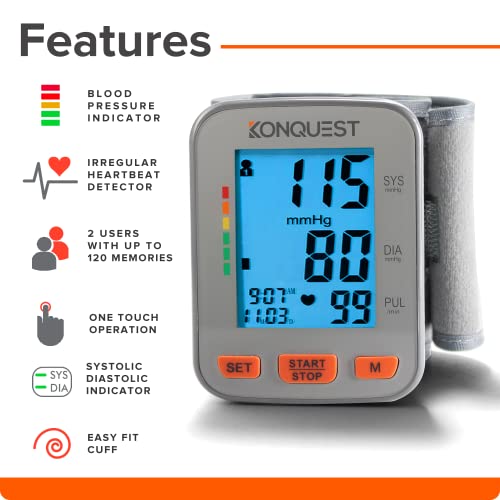
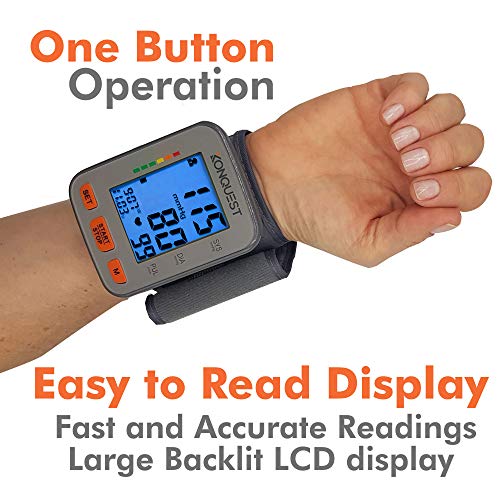
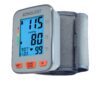
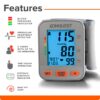
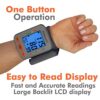
Where a wrist device is the right answer, this one is a straightforward two user machine with a case, a backlit display and one button operation. It records numbers for a clinician to look at. It is not a diagnostic device and it does not replace professional medical care.
Wrist size and the specifications that matter
The listing states that the cuff fits wrists from 5 and a quarter inches to 8 and a half inches in circumference. Our stored band size attribute records only 8.5 inches, dropping the lower bound, so use the full range from the listing. Measure the wrist you intend to use, just above the wrist bone, with a tape measure before ordering. Fit still decides the result. A wrist cuff that sits loose will not compress the artery properly, and the device will report a number rather than an error.
Memory, power and two junk fields
Two users can be selected and the device records up to 120 measurements in total with date and time stamps. Pulse rate is displayed alongside the pressure figures, and the device flags an irregular heartbeat when it detects one. The listing includes a storage and carrying case and an illustrated manual.
There is a contradiction over the batteries. The feature text states that two AAA batteries are included in the purchase, while the specification block states that two AAA batteries are required without confirming that they are supplied. Assume you may need a pair on hand. Two other stored fields are junk and should be ignored entirely: the item weight is recorded as 0.01 ounces, which is not a possible weight for a device with a pump and a display, and the product dimensions are recorded as 4 by 4 by 4 inches, which is a placeholder rather than a measurement.
Using it correctly, and what the readings are for
Wrist technique needs more care than arm technique, and the extra care is what makes the readings usable. Sit with your back supported and your feet flat on the floor, and rest quietly for several minutes before starting. Fit the cuff on a bare wrist, snug rather than tight, and then support your forearm, most simply with the other hand or on a cushion, so that the device sits at about the height of your heart. Hold still and stay silent while it inflates. Holding the wrist in your lap or up near your chin will change the number. Use the same wrist at about the same time each day.
What you produce is a record. What any reading means, whether a pattern across readings is significant, and whether anything about your care should change are questions for a healthcare professional who knows your history. This monitor does not replace professional medical care, and no reading from it should be used to start, stop or alter treatment on your own. The irregular heartbeat alert is a flag that the device noticed something during the measurement. It does not diagnose anything, and it is a reason to mention it at an appointment rather than a reason to interpret it yourself.
The accuracy claims, and what is missing behind them
This listing leans hard on accuracy language. The product title includes the word accurate. The feature text states that each device undergoes individual testing and describes the result in superlative terms, and it states that results are reliable in under a minute. We are not repeating those descriptions as findings. We do not test products, and no manufacturer statement about its own internal testing is the same as an independent assessment.
What is absent is any named validation protocol or independent assessing body. Home blood pressure monitors can be assessed against published protocols, and where a model has passed one the protocol is normally identified by name. Nothing of that kind appears here. If independent validation matters to your decision, and for a home monitor it reasonably might, check whether this specific model number appears on an independent validation listing before ordering.
Limits and gaps
No AC adapter is described, so this is a battery device, and battery life is not published. There is no app and no wireless connection, so 120 readings across two users is the full history unless you write them down. The display is described as large and backlit but no dimension is given. The listing is dated to 2017, so the design is not recent, and no warranty term appears in the record we hold.
The structural limit remains the one at the top of this page. A wrist monitor is more sensitive to arm position than an upper arm monitor, and unlike some competing wrist devices this listing does not describe a heart level positioning aid or a cuff tightness guide. That places the whole burden of correct positioning on the user.
Two habits improve what you get out of any device in this bracket. The first is to take a short series rather than a single reading, because a single measurement varies with posture, timing and how recently you moved. Two or three measurements a minute apart, written down together, is more informative than one. This model does not calculate that average for you, so the notebook does the work. The second is to keep the hard case in use rather than in a cupboard. A wrist monitor lives in a bag or a drawer, and the cuff and the internal tubing are the parts that suffer from being crushed.
Alternatives worth comparing
Within the same brand, the Konquest KBP-2704A is the sibling listing. Among other wrist devices, the Omron BP6350, which includes heart level and cuff wrap guidance addresses the positioning problem directly, the HoMedics BPW-O300 is a close competitor, and the SureLife WRS-35H is another. If an upper arm cuff would fit you, the Omron 5 Series BP742N is the type of device usually recommended first. Our index of home monitors and cuffs separates wrist listings from arm listings.
Who should buy it and who should not
Buy it if a wrist device suits your situation, your wrist measures between 5.25 and 8.5 inches, two people will share it, and you are willing to be disciplined about arm position. Do not buy it as a first monitor if an upper arm cuff would fit, do not rely on the accuracy language in the listing as validation, and take whatever you record to a clinician.